

- Rethinking Revenue Metrics
Your RPM Isn’t Lying to You. But It Might Not Be Telling the Whole Truth.
4 min read
•
•

If you’ve ever looked at your RPM and thought “that doesn’t feel quite right,” you’re probably on to something.
RPM, or revenue per mille, measures how much revenue you earn per thousand sessions. It’s one of the most-watched numbers in a publisher’s dashboard, the gut-check metric, the one you scan first thing in the morning and bring up in every performance conversation. But the way it’s traditionally calculated has a flaw baked in, and it’s one the industry has largely just accepted.
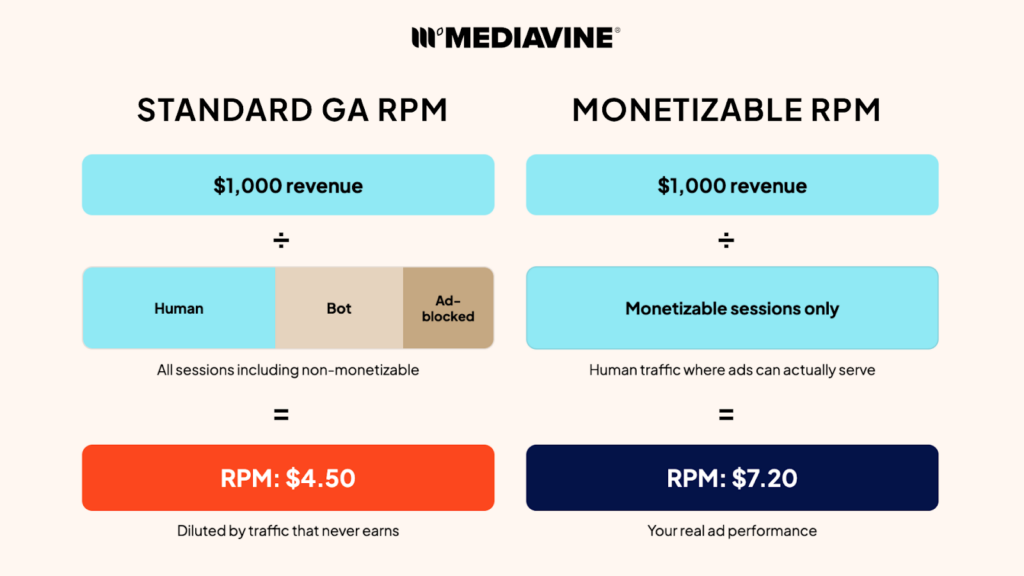
Here’s the issue: standard GA RPM divides your revenue by all of your sessions. Every single one. The human visits, the bot traffic, the ad-blocked sessions, the visits where no ad could ever have served. All of that non-monetizable traffic sits in the denominator, dragging your RPM down and making your revenue performance look worse than it actually is.
Think of it this way: if you ran a coffee shop, you wouldn’t measure sales per customer by counting everyone who walked past the window. You’d count the people who actually came inside. GA RPM is counting the window-shoppers.
You’re not seeing how your monetizable traffic is truly performing. You’re seeing it diluted by traffic that was never going to generate revenue.
Why This Matters More Than You Might Think
The distortion isn’t just a reporting inconvenience. It affects real decisions. When you test a new ad layout, shift your content strategy, or try to understand why revenue moved in a given week, you’re making those calls against a metric that lumps your actual ad-eligible audience in with traffic that was never in play. That makes it genuinely harder to know what’s working, and what isn’t.
It also makes comparisons unreliable. Two sites with identical monetized performance can show very different RPMs depending on how much non-monetizable traffic each one carries. The number looks objective. The comparison rarely is.
What a Cleaner Signal Looks Like
The fix is straightforward: measure revenue against the traffic that can actually generate it: monetizable sessions only.
When you do that, things get sharper in ways that matter:
- Testing becomes more useful. Layout changes, content strategies, or audience experiments that looked inconclusive against a noisy metric are easier to read when the signal is clean.
- Trends are easier to trust. Revenue movement that looked flat can show real growth once you remove traffic that was never going to convert.
- Decisions become more informed. Whether you’re thinking about ad placement, content investment, or audience growth, you’re working from numbers that reflect reality.
Your RPM should tell you what your audience is actually worth to advertisers. Not a diluted average that includes visitors who were never going to see an ad.
The Metric You Use Shapes Every Decision You Make
When testing, optimization, and growth strategy all run through RPM, the quality of that number matters. A diluted signal doesn’t just make reporting harder to read. It makes it harder to know what’s actually working. Publishers who understand how their metrics are calculated, and demand better ones, will make sharper decisions and have a clearer picture of where their business actually stands.
That starts with asking a better question: not just what your RPM is, but exactly what it’s measuring.
At Mediavine, this is exactly the problem we’ve been working to solve.
About the author

Share this page

The Mediavine Difference
You build content that defines industries.
We build the monetization that powers it.