

- How to Increase Your Earnings
Using Monetized RPM to Optimize Revenue Performance
4 min read
•
•

Many publishers see that their Monetized RPM (mRPM) is higher than their standard RPM and stop there. But comparing the two can reveal valuable insights. The gap between those two numbers is actually telling you something, and the publishers who learn to read it will optimize their revenue in ways that were never possible with standard RPM.
Here’s how to use both together to your advantage.
Start With the Gap
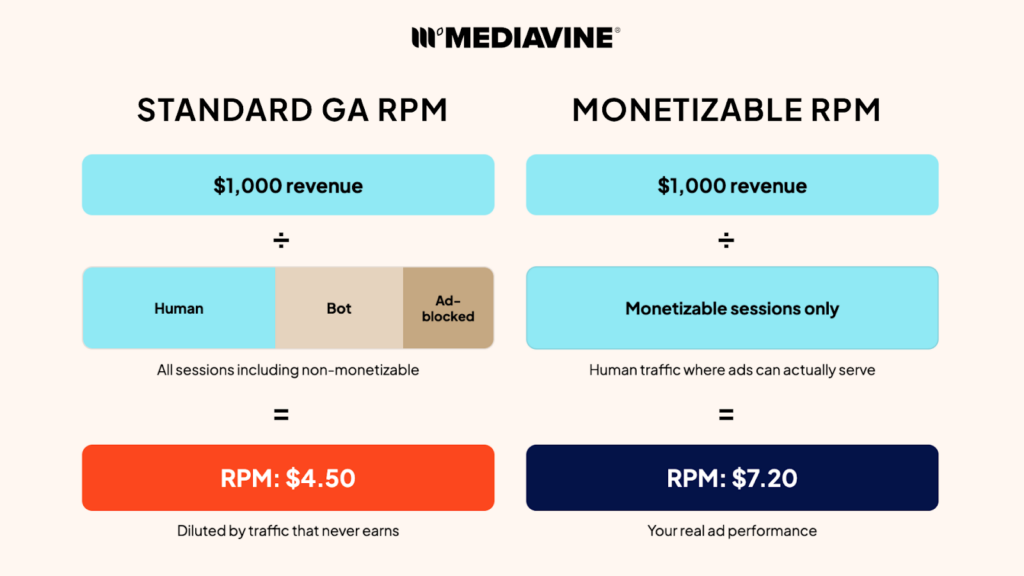
Your standard RPM counts every session. Your mRPM counts only the sessions where ads were able to serve, meaning sessions where ads had a real chance to load and generate revenue. The difference between those two numbers tells you how much of your traffic is not fully monetizable.
A big gap means a significant portion of your sessions are unmonetizable. A small gap means most of your traffic is ad-eligible. That gap varies widely depending on your traffic sources, the countries your readers come from, and how your consent management platform is set up. The most common reasons sessions go unmonetized include:
- Traffic from regions with low or no advertiser demand
- Invalid or non-human traffic, including AI bot crawlers
- Privacy consent restrictions
- Content category restrictions implemented on the advertiser side
- Ad blockers
Neither end of that range is inherently good or bad. It’s simply your starting point and it shapes every other decision below.

1. Which Pages Are Actually Making You Money?
Traffic volume and monetization value are not always aligned. A post driving 50,000 sessions can earn less than a post driving 10,000 sessions, depending on the quality of that traffic. mRPM makes that visible.
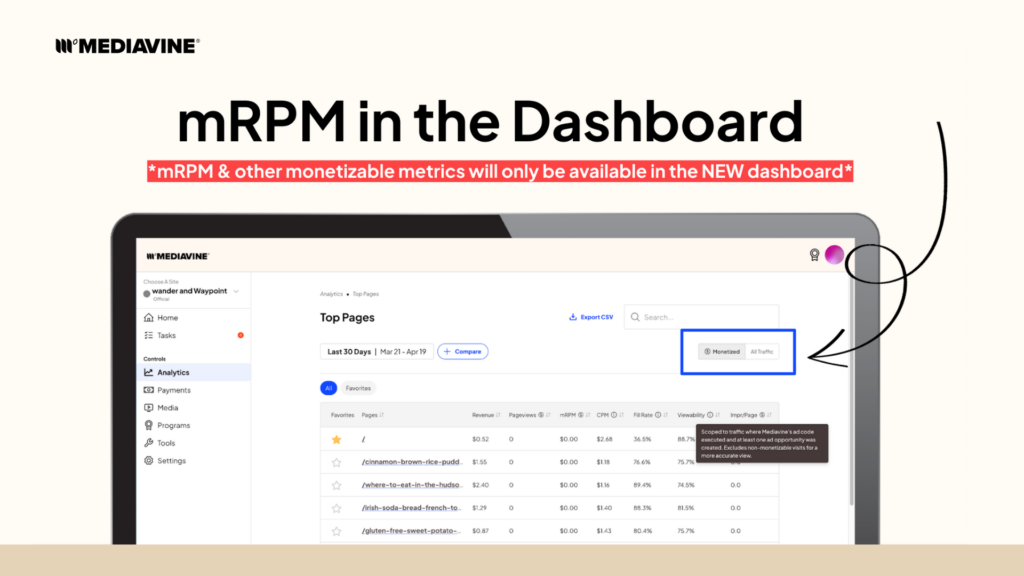
In your Mediavine dashboard, look at mRPM alongside monetizable session volume at the page level.
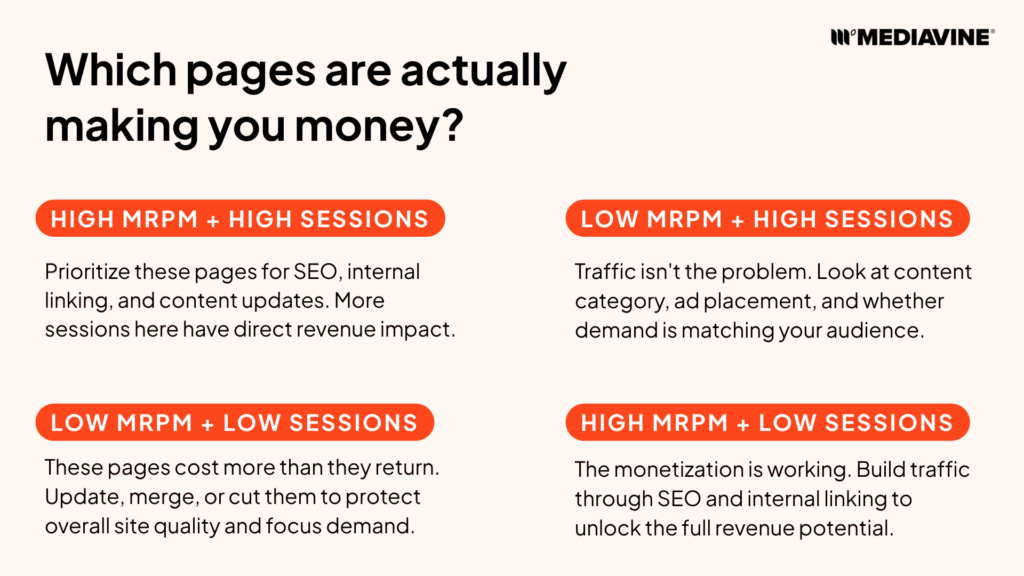
High mRPM + high sessions
Your strongest pages. Advertisers are competing for this audience and paying for it. Update the content, build related posts, and drive more traffic here. More sessions on these pages have direct revenue impact.
Low mRPM + high sessions
Traffic is there, revenue isn’t. There are a number of reasons this can happen, like geographic, source-based, or technical. Identify the root cause before investing further.
Low mRPM + low sessions
These pages are neither driving traffic nor earning revenue. Audit them, update them, consolidate them, or redirect traffic to stronger pages.
High mRPM + low sessions
These pages monetize well but aren’t reaching enough people. Advertiser demand exists. The opportunity is building an audience for it. Prioritize SEO, internal linking, and related content to grow sessions here.
2. Where Is Your Traffic Actually Coming From?
Some channels consistently deliver readers who monetize more efficiently. Others just inflate your session count. Now you can tell the difference.
Look at your traffic sources, search, social, direct, referral, and compare the percentage of sessions from each source where ads actually served. The sources with strong rates are where your time pays off. The ones with low rates are worth a harder look before you put more effort into them.
Social traffic often skews lower here, but that doesn’t mean it’s worthless. It drives audience growth and brand visibility. Knowing the trade-off means you can make an intentional decision about it rather than just wondering why your numbers look the way they do.
3. Geography Matters More Than You Might Think
Advertisers bid more aggressively in certain markets, primarily the United States, United Kingdom, Canada, and Australia. In other regions, fewer advertisers compete for your inventory, which means lower rates and fewer monetizable sessions.
If a significant share of your readers come from lower-demand regions, your monetizable session percentage will reflect that. Use that data to guide your content and SEO focus over time. Topics with strong search volume in high-demand markets will consistently monetize better than topics that primarily attract audiences from lower-demand regions.
This isn’t an overnight fix. But tracking your geographic monetizable session percentage over time will show you whether your efforts are moving in the right direction.
4. When Your Revenue Shifts, Here’s How to Diagnose It
See a boost or drop in RPM? Typically, publishers guess at why but mRPM removes some of that guesswork.
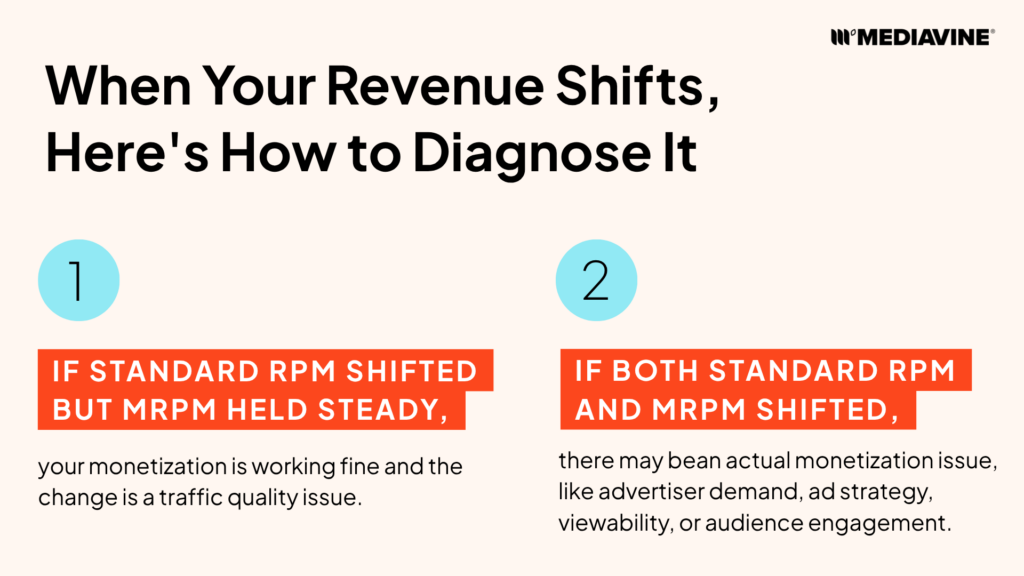
When your revenue shifts in either direction, compare standard RPM against mRPM. Two scenarios tell you two very different things.
Standard RPM shifted but mRPM held steady.
Your monetization is working fine. The change is a traffic quality issue, more or fewer unmonetizable sessions coming in from a new source, a viral post that attracted bot traffic, or a seasonal influx from a lower-demand region. The issue may be more related to traffic quality than ad strategy. It is a traffic source audit.
Both standard RPM and mRPM shifted.
This points to an actual monetization issue, like advertiser demand, ad strategy, viewability, or audience engagement. A boost here means your ad setup and content are firing on all cylinders. A drop is worth digging into and worth a conversation with your Account Manager.
Knowing which scenario you are in saves you from making the wrong fix. Changing your content strategy in response to a traffic quality problem solves nothing. And celebrating a traffic win when your monetization is actually what improved? That’s worth knowing too.
5. Use Both Numbers
Standard RPM and mRPM aren’t in competition. They’re two parts of the same picture.
Standard RPM reflects how your overall site is performing. It includes every session, monetizable or not. It’s your broadest view of growth. mRPM shows how your advertising is actually performing on the sessions where it had a real chance. It’s your measure of monetization efficiency.
Setting performance goals against standard RPM alone means measuring yourself against sessions that could never contribute to revenue. That’s not a useful benchmark for ad performance. But dropping standard RPM entirely means losing sight of how your overall audience is growing.
Keep both in view. Track your monetizable session percentage separately and watch it move over time as your traffic quality improves. Monitoring both gives you the full story.
Where to Start
Log into your Mediavine dashboard and pull your page-level data. The gap between your highest and lowest mRPM pages is where the clearest opportunities will show up. Start there, find the pattern, and build your strategy from what you uncover.
Questions about what you’re seeing? Reach out to your Account Manager or visit the Mediavine Help Center.
About the author

Share this page