

- Go for Teal
Shorter Sentences and Paragraphs For Larger RPMs
•
In other words, you need web-friendly formatting.
Usability.gov, which is run by the Digital Communications Division of the U.S. Department of Health and Human Services, has a great article on how to write for the web. It features a lot of great information – some we’ve already passed on, such as using more images to tell your story – including today’s focus on shorter sentences and paragraphs. How long should web-friendly sentences be? Sentences should be no longer than 20 words each, meaning that you probably need to shorten yours. (Fun fact: We just shortened that one from 22 to 17.) Remember, you can begin sentences with with “and,” “but,” “or,” etc., on the web. Your 11th grade English teacher is not lurking over your shoulder. Ditch the semicolons. And the dashes. Make fragmented thoughts your friend. It’s a different mindset, but sentences can and should be short on the web! Even crazier than that is how short your paragraphs should be, and on that front we differ from the aforementioned HHS article. They recommend no more than five sentences per paragraph, although they tellingly never use more than three in the article itself.
Why only 1-2 sentences per paragraph, and at most 3?
Because we’re focused not only for the web, but for the mobile web, where even big screens are small. Especially with your larger font size, even 1-2 sentences can take up real space. Put another way, if you’re writing standard, five-sentence paragraphs like you might see in print, in all likelihood you’re scaring off your mobile web audience with a wall of text.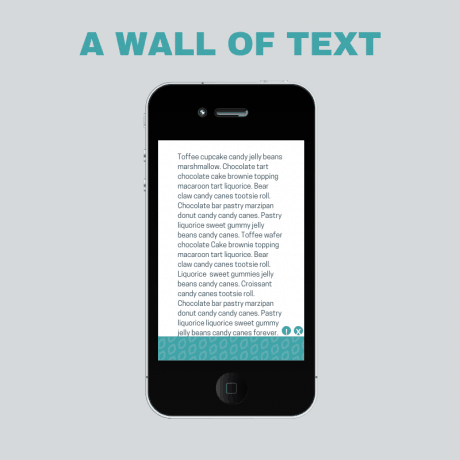 If a paragraph takes up most or all of a phone’s screen with no white space or paragraph breaks, it immediately looks and feels daunting for readers.
So what are they going to do? Scroll right past it.
The remedy for this is pretty simple: Hit the enter key early and often. Each paragraph should be one thought, and quickly digestible by the reader.
If a paragraph takes up most or all of a phone’s screen with no white space or paragraph breaks, it immediately looks and feels daunting for readers.
So what are they going to do? Scroll right past it.
The remedy for this is pretty simple: Hit the enter key early and often. Each paragraph should be one thought, and quickly digestible by the reader.
Pin this post!
What do sentence and paragraph length have to do with RPM?
In the modern area of ad viewability, publishers are only paid for viewable ads. If a user is scrolling past your content, they’re also skipping all or most of your ads. Even if a user sees an ad and you do get paid, it’s not a binary proposition. You want them to be more “engaged” with it, or seeing it for longer. Advertisers look at this as part of their ROI (return on investment), and want to buy the ad inventory they believe is most worthwhile. You want your users reading your content and staying engaged, and audiences are more engaged with shorter sentences and paragraphs. Period. Moreover, Mediavine’s in-content ad logic won’t break up paragraphs, since we don’t disrupt the flow of your content. Hitting enter more often gives us more opportunities to place ads. We follow the Coalition for Better Ad Standards in determining how many ads we insert, so this won’t mean too many ads, or even a greater amount necessarily. This just means better placed ads throughout your content, which we look at as a win-win for both the bottom line and user experience.It sounds too good to be true, but hitting the enter key more often is one of simplest, proven ways to improve RPM.
As with any of our tips on that front, revisit your top 10 posts, and make sure you do this for new posts going forward and you should be in good shape. If you’re about to promote a post, or see something that’s trending, go in and fix it. Those extra enter keystrokes will more than pay for themselves.About the author

Share this page