

- How to Stay Ahead of Industry Trends
Navigating AI Search: How We’re Advocating and Building for Publishers
4 min read
•
•
Our legal team is taking publishers’ case to Washington to protect your content from AI scrapers. And in your dashboard, we’re building tools to help every visit to your site earn more as search changes.
Google’s AI Overviews, AI Mode, and ongoing algorithm updates are cutting into organic search traffic across the industry. We’re not going to pretend that’s a small problem, or one we’ve fully solved, but you shouldn’t have to wonder what’s happening behind the scenes. Here’s where we stand and what we’re doing about it.
In this post, you’ll find:
- How we’re taking publishers’ case to Washington
- Whether you should block AI crawlers
- What we’re building in Mediavine Labs
- How we’re protecting your revenue long-term
- Where search traffic is actually going
Taking Publishers’ Case to Washington
Publisher content is used to train and power the AI systems changing how people find information. That value deserves recognition and fair compensation. But first, publishers need to know who is accessing their content and how it’s being used.
Some crawlers are legitimate and identify themselves. Others pose as human visitors, scrape content at scale, and resell it to AI developers. Because they hide their identity, publishers often can’t tell them apart from real readers or effectively block them. Research cited by the News/Media Alliance found that 95% of top websites can’t fully block scrapers.
So we took it to Congress.
Mediavine was founded by publishers, and we’re still publishers today. We own The Hollywood Gossip, which recently joined the News/Media Alliance, the industry group that represents publishers on policy.
Alongside the Alliance, and speaking for Mediavine and the 20,000+ independent publishers we work with, our General Counsel, Guillermo Torres, met with members of Congress and their staff. He urged support for the Stealth Bot Prohibition Act (H.R. 9915), a bipartisan bill that would require bots to identify themselves and their purpose when crawling websites.
Publishers can’t build a fair market for their content while anyone can take it for free. Stopping stealth scraping would give publishers back control of their work, and that control is what makes licensing and fair compensation possible. The bill won’t solve everything, but it’s a real first step.
We’ll keep showing up in Washington and wherever these decisions are made, representing the publishers we work with.
Should You Block AI Crawlers?
We don’t recommend blocking them across the board, at least not yet. As the owner of your business, the call is yours. Some crawlers serve legitimate purposes, from search engines to researchers and regulators, and right now it’s hard to tell the bad actors from the rest. Blocking too broadly could cut you off from traffic and discoverability you want to keep.
That’s the gap the Stealth Bot Prohibition Act is designed to close. If bots have to identify themselves, you can decide which ones to allow.
What We’re Building in Mediavine Labs
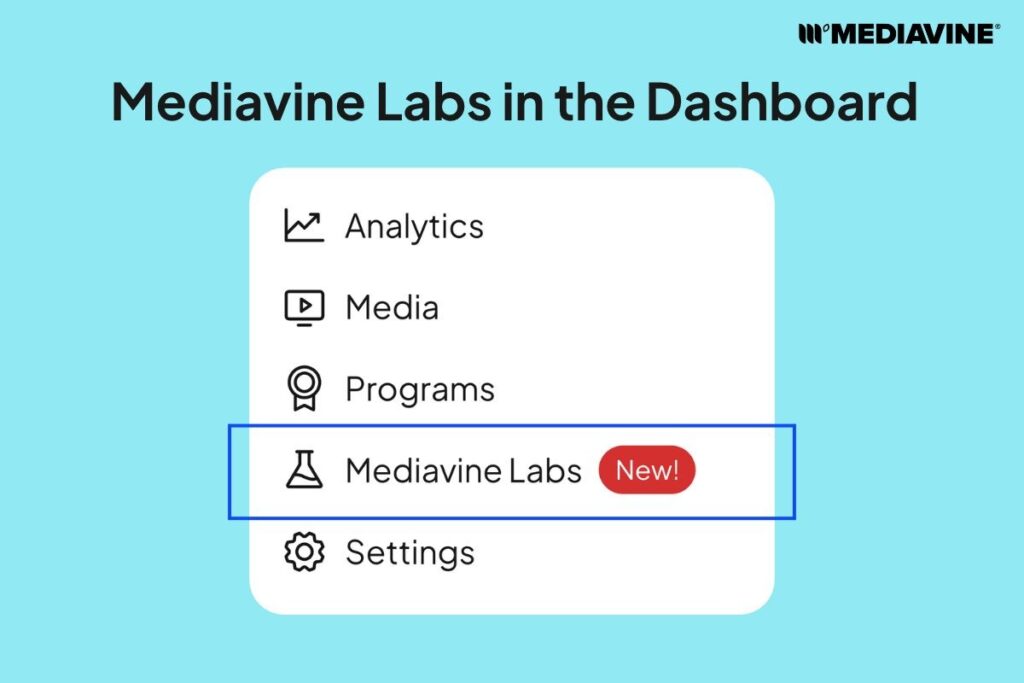
Advocacy is one part of the work. The other is building tools you can use today. Mediavine Labs is where we develop and test them, and it now has its own tab in our dashboard. Five are live now:
- Discover Optimizer scores your content against signals associated with Google Discover, and gives you a plain-language checklist to fix what’s holding a post back.
- SEO Insights connects your Search Console data to your real ad revenue, so you can see which pages are worth your time in dollars, not just clicks.
- Auto Pin keeps a steady stream of on-brand Pinterest pins going from your existing archive, so you can stay active on a channel beyond Google without adding to your workload.
- Video Maker creates videos from your existing posts, giving you another way to monetize the traffic you already have.
- House Ads lets you fill unsold ad space with your own promotions to promote your products, email signups, or internal pages. Instead of sitting empty, that space works for your business.
None of these will reverse AI Overviews. Each one is built for how readers will find content going forward, not just how search works today.
Protecting Your Revenue Long-Term
No one can tell you exactly where search traffic goes from here, but we can focus on what’s in our control.
More revenue from the traffic you have. The latest version of our Optimized Ad Experience adjusts ad density to each site’s viewability. Early testing showed RPM improvements even as overall traffic dipped slightly during the test period. Universal Player Plus and new high-impact ad units bring more advertiser demand to the readers you already reach.
An audience that doesn’t depend on search. Spotlight Subscribe helps you turn search visitors into email subscribers you can reach directly, with no algorithm in between.
A seat at the table as ad buying changes. AI is changing how advertisers find and buy ad inventory. As buying becomes more automated, the quality of your audience, content, and data will matter even more. We’re already connecting your audience directly to the AI buying agents that agencies and brands are starting to use, so you’re part of these new deals from the start. We’re also partnering with Apostra and Optable, and helping shape AdCP (Ad Context Protocol), an emerging standard for how AI buying and selling agents communicate.
Mediavine brings the same demand and technology to every visit, whether readers arrive from search, social, email, or straight to your site.
What the Traffic Data Actually Shows
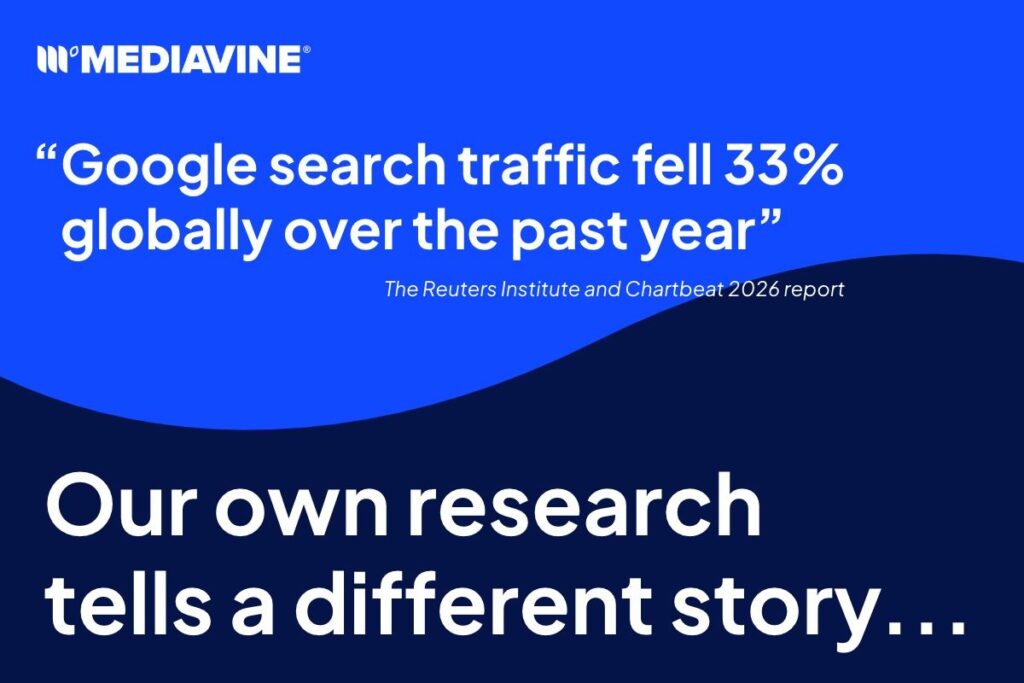
A 2026 Reuters Institute report, drawing on Chartbeat data, found publishers’ Google search traffic fell 33% globally over the past year, and Google Discover referrals dropped 21%.
The Mediavine network shows a different timeline. Our steepest drop came earlier, between late 2023 and mid-2024, after Google’s Helpful Content Update. Since then, the decline has slowed: Google search sessions fell about 12% from 2024 to 2025, and another 3% so far in 2026.
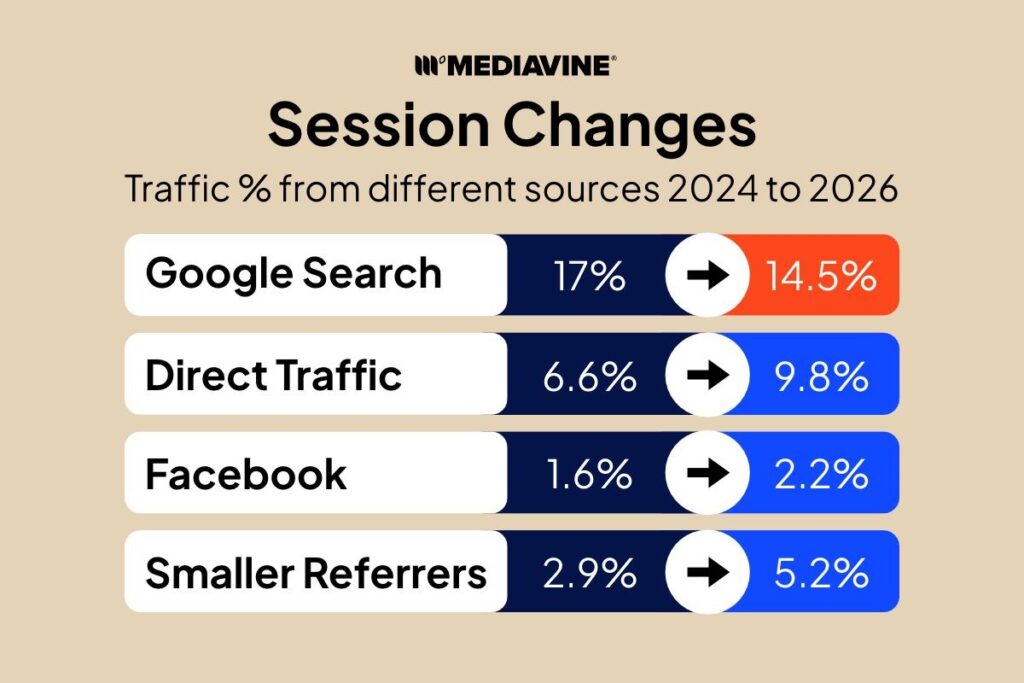
Meanwhile, total network sessions are growing this year. Google is still Mediavine publishers’ largest traffic source, but its share has dropped from 17.0% of network sessions in 2024 to 14.5% in 2026. Traffic isn’t disappearing. It’s spreading out:
- Direct traffic’s share grew 48.5%, from 6.6% to 9.8% of network sessions, the largest gain of any single source.
- Facebook’s share grew 37.5%, from 1.6% to 2.2%.
- Smaller referrers’ share grew 79.3%, from 2.9% to 5.2%.
The biggest risk now is relying too heavily on any single source.
Where We Go From Here
Our legal team is actively engaged on three fronts: the bill in Congress, action at the state level, and how courts rule on AI and copyright. In New York, the legislature passed its own Stealth Crawler Prohibition Act for news sites in June, and it now awaits the governor’s decision.
We’re not just watching and waiting. From Capitol Hill to the tools in your dashboard, we’re working to protect your content and your revenue, and we’ll keep you posted. For the latest, follow our social channels, read the Mediavine newsletter, and join our monthly publisher live sessions with Co-Founder and CEO Eric Hochberger and CRO Amanda Martin.
About the author

Share this page