

- Advertising
Keyword Anti-Targeting: What to Know, What to Avoid, and Why You Shouldn’t Worry
•
What keywords are the most blocked?
The below graphic of most-blocked keywords tells the story. Some are obvious and usually avoidable, but it’s a broader set of terms than you might think.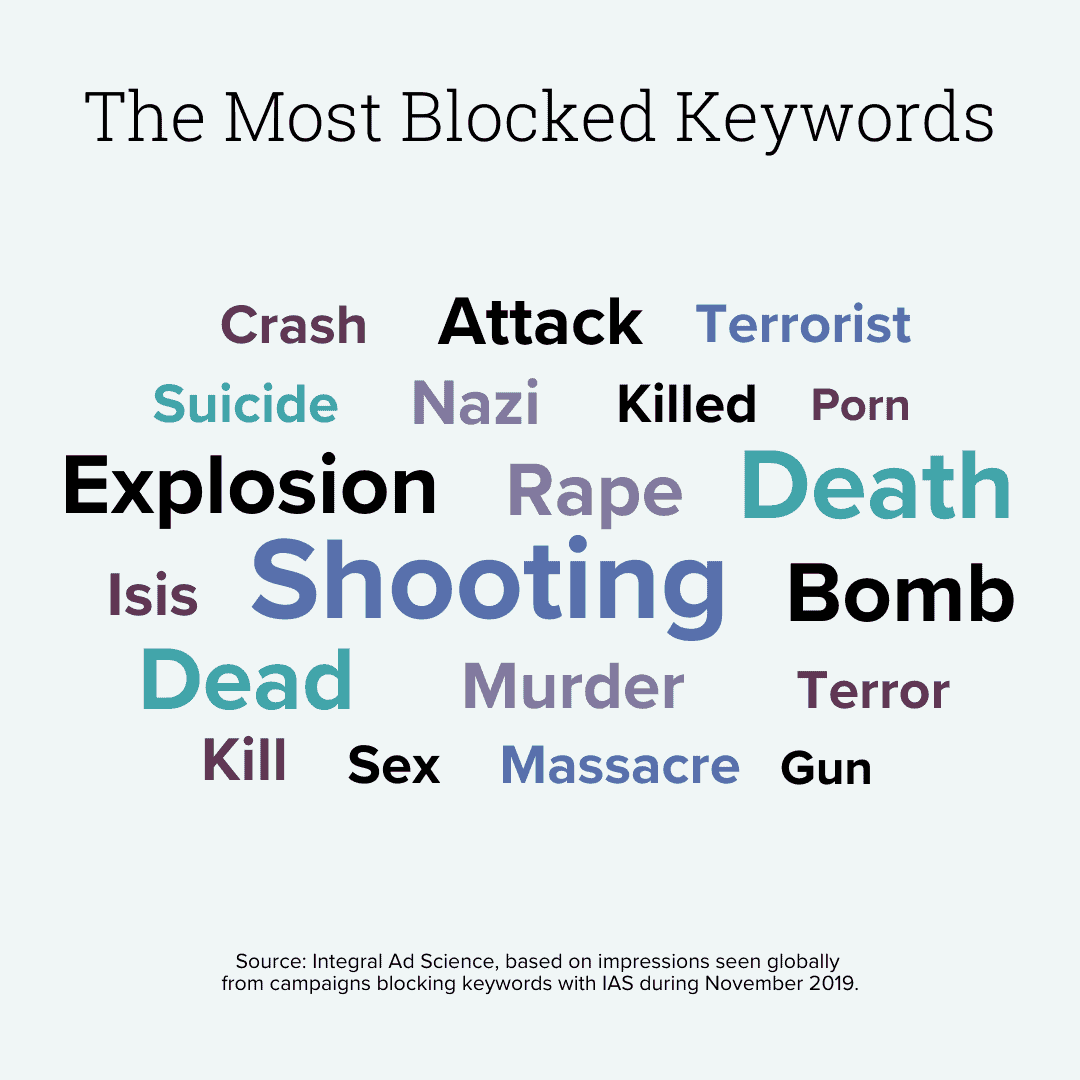 From violent terms like “killer” to general ones like “sex” and the now-ubiquitous “COVID” and “pandemic,” many common words are being blocked.
As we say on our list of Covid-19 related words to avoid, these seemingly arbitrary blockages can impact ad revenue in certain circumstances.
Keyword block lists and anti-targeting methods are designed with good intentions, of course, but don’t always work out as planned.
From celebrity gossip articles on the Duchess of Sussex Meghan Markle (note the word “sex” in her royal title) to your food blog’s “killer” brownie recipe, websites are potentially running afoul of keyword block lists and anti-targeting methods without realizing it.
Beyond those weird and slightly humorous examples, news sites in particular are hamstrung by this on a daily basis. Reporting on violent crimes or the global health crisis is their reason for being, yet it now means their traffic doesn’t monetize the same as it would have.
From violent terms like “killer” to general ones like “sex” and the now-ubiquitous “COVID” and “pandemic,” many common words are being blocked.
As we say on our list of Covid-19 related words to avoid, these seemingly arbitrary blockages can impact ad revenue in certain circumstances.
Keyword block lists and anti-targeting methods are designed with good intentions, of course, but don’t always work out as planned.
From celebrity gossip articles on the Duchess of Sussex Meghan Markle (note the word “sex” in her royal title) to your food blog’s “killer” brownie recipe, websites are potentially running afoul of keyword block lists and anti-targeting methods without realizing it.
Beyond those weird and slightly humorous examples, news sites in particular are hamstrung by this on a daily basis. Reporting on violent crimes or the global health crisis is their reason for being, yet it now means their traffic doesn’t monetize the same as it would have.
How does anti-targeting happen?
The most common way that anti-targeting works is through automated systems to pre-bid on a contextual basis in real-time as a page loads. There are several companies that make this technology available to advertisers to incorporate into their bidding strategies. One such example is Verity from GumGum, which scans web pages and makes them available for contextual targeting and anti-targeting. This technology is able to gauge the content risk of the actual words on the page, as well as the video and image content presented. This is far from a perfect method, which is why that “killer” brownie recipe has a lower RPM than more generically-titled recipes. Another simpler method of anti-targeting is the use of a crawler to scan pages, specifically URLs, passed through programmatic bids request and using only keywords from the URL. Some form of URL scanning technology is built into most DSPs.What should you do about it?
This is, unfortunately, a burden shouldered by web publishers that does not extend to traditional media. No one blocks ads from appearing on the Food Network because of a recipe’s name, or from the local news as it reports on who knows what. That being said, to use my least favorite cliche — it is what it is. As arbitrary, even unfair as this seems, programmatic advertising technology is always adapting to solve problems and there’s already been movement to ease these restrictions. Providers are aware of these issues, and are updating their technology to better incorporate page context, so that “killer cake” is differentiated from “killer shoots” for example. In any case, don’t let this consume or distract you from creating quality content your audience wants. Always post the content that makes sense for your visitors and, if you can avoid obvious words that you know advertisers steer clear of, this is helpful to keep in the back of your mind. Also keep in mind, though, that keyword block lists don’t keep Google from indexing your site or readers from finding it. Worst case is that fewer advertisers may bid on the inventory. As a result of this, a few posts may have less than optimal ad performance, but in all likelihood, this will not dramatically hurt website RPM overall. Mediavine recently added page-level reporting to our revamped Dashboard 2.0, allowing you to track which posts perform better than others.
There are countless other reasons why RPM changes from post to post, but page-level data is a great way to track and troubleshoot issues like this.
Also, consider the alternative:
Avoiding controversial terms altogether, if you have no choice but to use them in context, will only mean less traffic — and no money at all. Don’t cut off your nose to spite your face.
That being said, if you feel the need to use colorful language, definitely don’t use it in the URL, where it’s most easily scanned and blocked by DSPs.
And if you have the choice between calling your grandma’s recipe a “killer” brownie or the “greatest of all-time” brownie… I’d go with the latter.
Mediavine recently added page-level reporting to our revamped Dashboard 2.0, allowing you to track which posts perform better than others.
There are countless other reasons why RPM changes from post to post, but page-level data is a great way to track and troubleshoot issues like this.
Also, consider the alternative:
Avoiding controversial terms altogether, if you have no choice but to use them in context, will only mean less traffic — and no money at all. Don’t cut off your nose to spite your face.
That being said, if you feel the need to use colorful language, definitely don’t use it in the URL, where it’s most easily scanned and blocked by DSPs.
And if you have the choice between calling your grandma’s recipe a “killer” brownie or the “greatest of all-time” brownie… I’d go with the latter.
About the author

Share this page